

2.04: Phospholipids
- Page ID
- 4229
Phospholipids are fat derivatives in which one fatty acid has been replaced by a phosphate group and one of several nitrogen-containing molecules.
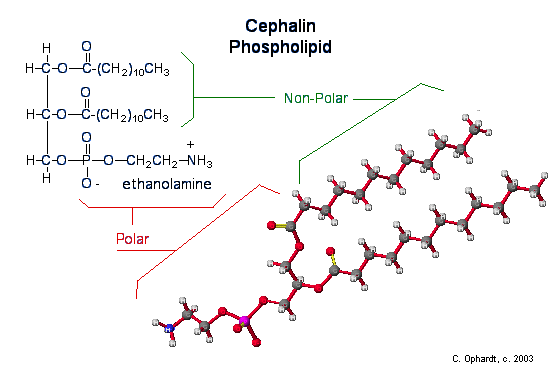 The structural formula shows glycerol ester-linked to two fatty acid tails, each written C(=O)(CH2)10CH3. A phosphate group links the third glycerol carbon to CH2CH2NH3+, labeled ethanolamine. Green brackets mark the two hydrocarbon tails as Non-Polar. Red brackets identify the phosphate-containing head region as Polar. The ball-and-stick model at the right shows the corresponding two elongated tails and head region.
Example 2.4.1: Phosphatidyl ethanolamine (also known as cephalin)
The hydrocarbon chains are hydrophobic (as in all fats). However, the charges on the phosphate and amino groups (in red) make that portion of the molecule hydrophilic. The result is an amphiphilic molecule.
 Diagram of a phospholipid bilayer, drawn vertically so the two leaflets appear as left and right layers. Each layer is a single column of dark blue circles representing the polar (hydrophilic) heads; a label at the top, "Polar heads," has arrows pointing to the circles in both columns. Between the two head columns, wavy orange lines representing the hydrophobic hydrocarbon tails extend horizontally from each head toward the center, where tails from opposing leaflets face one another; a label at the bottom, "Hydrocarbon tails," has arrows pointing to these wavy lines. The regions on the far left and far right of the bilayer are shaded light blue and each labeled "Aqueous," indicating the water-based environment (such as extracellular fluid or cytosol) that the polar heads face. The arrangement illustrates the amphiphilic nature of phospholipids: hydrophilic heads oriented outward toward the aqueous surroundings on both sides, and hydrophobic tails sequestered inward, away from water, forming the interior of the membrane.
Phospholipids like phosphatidyl ethanolamine are major constituents of cell membranes. These molecules form a phospholipid bilayer with their hydrophilic (polar) heads facing their aqueous surroundings (e.g., the cytosol) and their hydrophobic tails facing each other.