

4.10: Chemiosmosis
- Page ID
- 4274
Several kinds of evidence support the chemiosmotic theory of ATP synthesis in chloroplasts. When isolated chloroplasts are illuminated, the medium in which they are suspended becomes alkaline — as we would predict if protons were being removed from the medium and pumped into the thylakoids (where they reduce the pH to about 4.0 or so). The interior of thylakoids can be deliberately made acid (low pH) by suspending isolated chloroplasts in an acid medium (pH 4.0) for a period of time. When these chloroplasts are then transferred to a slightly alkaline medium (pH 8.5), that is, one with a lower concentration of protons and given a supply of ADP and inorganic phosphate (Pi), they spontaneously synthesize ATP. No light is needed.
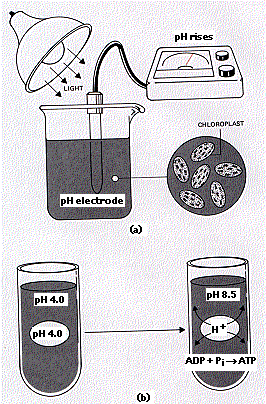 Two-part diagram (a and b) demonstrating the chemiosmotic theory of ATP synthesis in chloroplasts. Part (a): A lamp at upper left labeled 'LIGHT' shines downward, indicated by arrows, onto a beaker filled with a dark suspension. A 'pH electrode' is immersed in the beaker and connects by a cable to a pH meter at upper right whose display reads 'pH rises.' A circular magnified inset, linked by a line to the beaker's contents, shows several lens-shaped organelles labeled 'CHLOROPLAST.' This depicts that illuminating isolated chloroplasts makes the surrounding medium alkaline as protons are pumped into the thylakoids. Part (b): Two test tubes joined by a rightward arrow showing a sequence. The left tube holds dark medium labeled 'pH 4.0' with a lighter oval inside also labeled 'pH 4.0,' representing chloroplasts equilibrated in acid medium. The right tube holds dark medium labeled 'pH 8.5' with a lighter oval labeled 'H+' and an arrow pointing from inside the oval outward into the medium; below the oval, inside the tube, is the reaction 'ADP + Pi ??? ATP.' This shows that when acid-loaded chloroplasts are transferred to alkaline medium, protons flow out down their gradient and drive ATP synthesis without light.
This is a direct evidence that a gradient of protons can be harnessed to the synthesis of ATP.