

4.11: Metabolism
- Page ID
- 4275
All living things must have an unceasing supply of energy and matter. The transformation of this energy and matter within the body is called metabolism.
Catabolism and Anabolism
Catabolism is destructive metabolism. Typically, in catabolism, larger organic molecules are broken down into smaller constituents. This usually occurs with the release of energy (usually as ATP). Anabolism is constructive metabolism. Typically, in anabolism, small precursor molecules are assembled into larger organic molecules. This always requires the input of energy (often as ATP).
Autotrophic vs. Heterotrophic Nutrition
Green plants, algae, and some bacteria are autotrophs ("self-feeders"). Most of them use the energy of sunlight to assemble inorganic precursors, chiefly carbon dioxide and water, into the array of organic macromolecules of which they are made. The process is photosynthesis. Photosynthesis makes the ATP needed for the anabolic reactions in the cell. All other organisms, including ourselves, are heterotrophs. We secure all our energy from organic molecules taken in from our surroundings ("food"). Although heterotrophs may feed partially (as most of us do) or exclusively on other heterotrophs, all the food molecules come ultimately from autotrophs. We may eat beef but the steer ate grass. Heterotrophs degrade some of the organic molecules they take in (catabolism) to make the ATP that they need to synthesize the others into the macromolecules of which they are made (anabolism).
How humans (and other animals) do it
Humans are heterotrophs. We are totally dependent on ingested preformed organic molecules to meet all our energy needs. We are also dependent on preformed organic molecules as the building blocks to meet our anabolic needs.
 An oval body outline surrounds a continuous passage labeled Mouth, Stomach, Intestine and Anus. Liver and Pancreas connect to the digestive passage. Green outlines identify a nostril/lung pathway and a sweat gland opening at the body surface. A blue kidney pathway and pink reproductive tract each lead separately to the exterior near the lower right. The simplified drawing emphasizes continuity with the outside, rather than anatomical positions.
The steps for converting food to energy in animals:
- Ingestion: taking food within the body (although as the figure shows, it is still topologically in the external world, not the internal).
- Digestion: The enzyme-catalyzed hydrolysis of polysaccharides (e.g., starch) to sugars, proteins to amino acids, fats to fatty acids and glycerol, and nucleic acids to nucleotides.
- Absorption into the body and transport to the cells.
- Absorption into cells.
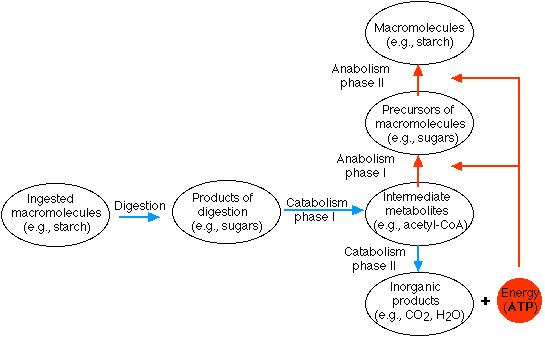 Flowchart of metabolic pathways. Left to right: an oval labeled 'Ingested macromolecules (e.g., starch)' connects via a blue arrow labeled 'Digestion' to an oval 'Products of digestion (e.g., sugars)'. A blue arrow labeled 'Catabolism phase I' leads to an oval 'Intermediate metabolites (e.g., acetyl-CoA)'. From this central oval, a downward arrow labeled 'Catabolism phase II' leads to an oval 'Inorganic products (e.g., CO2, H2O)', accompanied by a red circle labeled '+ Energy (ATP)'. Upward arrows labeled 'Anabolism phase I' and 'Anabolism phase II' lead from intermediate metabolites to 'Precursors of macromolecules (e.g., sugars)' and then to 'Macromolecules (e.g., starch)'. Red arrows from the Energy (ATP) circle point to both anabolism arrows, indicating ATP released by catabolism powers the anabolic (biosynthetic) phases.
Within cells, these molecules are further degraded into still simpler molecules containing two to four carbon atoms. These fragments (acetyl-CoA for example) face one of two alternatives. They may proceed up various metabolic pathways and serve as the building blocks of, for example, sugars and fatty acids. From these will be assembled the macromolecules of the cell (e.g., polysaccharides, fats, proteins, and nucleic acids). Alternatively, the molecules in this pool of two- to four-carbon fragments may be still further degraded — ultimately to simple inorganic molecules such as carbon dioxide (CO2), H2O, and ammonia (NH3). This phase of catabolism releases large amounts of energy (in the form of ATP). One use to which this energy is put is to run the anabolic activities of the cell.