

5.05: DNA Replication
- Page ID
- 4284
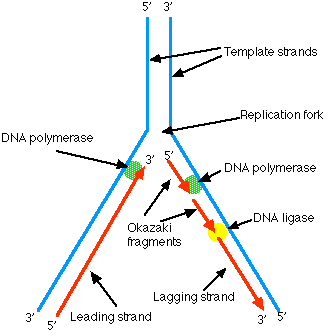 Blue template strands split at a Y-shaped replication fork. On the left, a continuous red leading strand has its growing 3??? end at DNA polymerase near the fork. On the right, red Okazaki fragments form the lagging strand; DNA polymerase extends a fragment and DNA ligase joins fragments farther down. Labels mark template strands, replication fork, both polymerases, Okazaki fragments and ligase. The 5??? and 3??? ends show that each new strand is antiparallel to its template and grows 5??? to 3???.
With their multiple origins, how does the eukaryotic cell know which origins have been already replicated and which still await replication?
An observation: When a cell in G2 of the cell cycle is fused with a cell in S phase, the DNA of the G2 nucleus does not begin replicating again even though replication is proceeding normally in the S-phase nucleus. Not until mitosis is completed, can freshly-synthesized DNA be replicated again.
Two control mechanisms have been identified — one positive and one negative. This redundancy probably reflects the crucial importance of precise replication to the integrity of the genome.
Licensing: positive control of replication
In order to be replicated, each origin of replication must be bound by:
- an Origin Recognition Complex of proteins (ORC). These remain on the DNA throughout the process.
- Accessory proteins called licensing factors. These accumulate in the nucleus during G1 of the cell cycle. They include:
- Cdc-6 and Cdt-1, which bind to the ORC and are essential for coating the DNA with
- MCM proteins. Only DNA coated with MCM proteins (there are 6 of them) can be replicated.
Once replication begins in S phase,
- Cdc-6 and Cdt-1 leave the ORCs (the latter by ubiquination and destruction in proteasomes).
- The MCM proteins leave in front of the advancing replication fork.