

5.07: Restriction Enzymes
- Page ID
- 4286
Restriction enzymes are DNA-cutting enzymes found in bacteria (and harvested from them for use). Because they cut within the molecule, they are often called restriction endonucleases. To be able to sequence DNA, it is first necessary to cut it into smaller fragments. Many DNA-digesting enzymes (like those in your pancreatic fluid) can do this, but most of them are no use for sequence work because they cut each molecule randomly. This produces a heterogeneous collection of fragments of varying sizes. What is needed is a way to cleave the DNA molecule at a few precisely-located sites so that a small set of homogeneous fragments are produced. The tools for this are the restriction endonucleases. The rarer the site it recognizes, the smaller the number of pieces produced by a given restriction endonuclease.
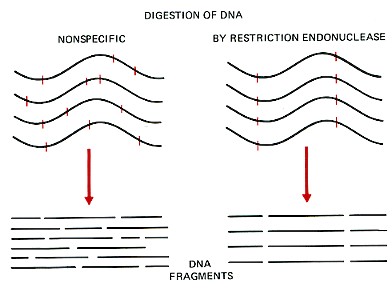 Four DNA molecules appear in each panel. On the left, nonspecific cut marks occur at different positions on each molecule, producing many irregular fragment lengths. On the right, restriction-endonuclease cut marks align at corresponding positions, producing repeated groups of matching lengths. The restriction fragments within one molecule are not all the same length; the pattern is reproducible across copies.
A restriction enzyme recognizes and cuts DNA only at a particular sequence of nucleotides. For example, the bacterium Hemophilus aegypticus produces an enzyme named HaeIII that cuts DNA wherever it encounters the sequence
5'GGCC3'
3'CCGG5'
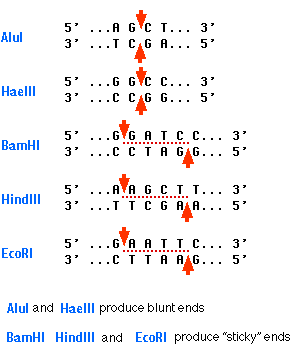 Each upper strand runs 5??? to 3??? and the complementary lower strand runs 3??? to 5???. A vertical bar below represents the cut marked by an orange arrow in the image.
AluI: upper AG|CT; lower TC|GA.
HaeIII: upper GG|CC; lower CC|GG.
BamHI: upper G|GATCC; lower CCTAG|G.
HindIII: upper A|AGCTT; lower TTCGA|A.
EcoRI: upper G|AATTC; lower CTTAA|G.
AluI and HaeIII produce blunt ends. BamHI, HindIII and EcoRI produce staggered, sticky ends.
The cut is made between the adjacent G and C. This particular sequence occurs at 11 places in the circular DNA molecule of the virus φX174. Thus treatment of this DNA with the enzyme produces 11 fragments, each with a precise length and nucleotide sequence. These fragments can be separated from one another and the sequence of each determined. HaeIII and AluI cut straight across the double helix producing "blunt" ends. However, many restriction enzymes cut in an offset fashion. The ends of the cut have an overhanging piece of single-stranded DNA. These are called "sticky ends" because they are able to form base pairs with any DNA molecule that contains the complementary sticky end. Any other source of DNA treated with the same enzyme will produce such molecules. Mixed together, these molecules can join with each other by the base pairing between their sticky ends. The union can be made permanent by another enzyme, a DNA ligase, that forms covalent bonds along the backbone of each strand. The result is a molecule of recombinant DNA (rDNA).
The ability to produce recombinant DNA molecules has not only revolutionized the study of genetics, but has laid the foundation for much of the biotechnology industry. The availability of human insulin (for diabetics), human factor VIII (for males with hemophilia A), and other proteins used in human therapy all were made possible by recombinant DNA.
Artificial Restriction Enzymes
In addition to the many natural restriction enzymes isolated from bacteria and archaea, it is now possible to synthesize artificial restriction enzymes that cut DNA at any desired sequence. Examples:
- zinc-finger nucleases
- TALENs
- CRISPR RNA molecules