Dev LibreTexts

1.07: Adjectifs

  • Page ID
    6690
  • Adjectives are used to describe people and things.

    In French, adjectives agree with the nouns and pronouns they modify

    • in gender (masculine or feminine) and
    • in number (singular or plural).

    ☞ Paul est français. Virginie est française.
    Jean et Richard sont intelligents. Anne et Kate sont intelligentes.

    Adjectives that end in –e in the masculine singular remain the same in the feminine singular.

    Table comparing linguistic terms: "singular" and "plural" with their meanings and English translations.

    ☞ Paul est intelligent. Virginie est intelligente.

    Adjectives that end in –s or –x in the masculine singular remain the same in the masculine plural.

    Paul est courtois. Antoine et Vincent sont courtois.

    ☞ Jean est sérieux. Marc et Henri sont sérieux.

    Adjectives that do not follow the above patterns are irregular.

    Pronunciation

    Table comparing restrictions and planets, listing attributes and corresponding examples for each category.
    Adjectifs irréguliers

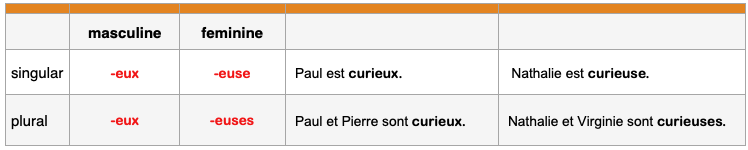
    Many irregular adjectives have their own patterns.

    • adjectives in -eux
    Table listing types of files and their attributes, including "original" with description and "jpeg" with details on image format.
    • adjectives in -al
    Table comparing two items: "mangú" and "puré." Descriptions provided in Spanish under each category.
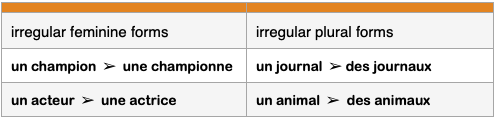
    • adjectives with irregular feminine forms
    Table listing Spanish words and their meanings, with categories for masculine and feminine forms.

    Note: nouns that have endings similar to the above adjectives usually follow the same patterns.

    A table comparing irregular feminine and plural forms in French, showcasing examples like "un champion" to "une championne."
    La place des adjectifs

    Note the position of the adjectives in the sentences on the right in the examples below.

    ☞ J’ai un copain. J’ai un copain italien.

    ☞ J’ai un cousin. J’ai un cousin sympathique.

    In French, most adjectives come AFTER the noun.

    A few common adjectives come BEFORE the noun.

    Table listing names and their meanings in different languages, with explanations in each row.

    A good way to remember which adjectives are placed before the noun is to remember the English phrase “MA BRAGS”.

    A formatted table displaying French words and their English translations, with columns for "Name," "Effort/Worker," "Bounty," "Rank," "Age," "Graduation," and "Star."

    *Note: the forms bel, vieil, and nouvel are used only before a masculine singular noun that begins with a vowel or a silent ‘h’.

    ☞ Vincent est un bel homme.

    ☞ J’habite dans un nouvel appartement.

    Template:AutoDefinitionList

    1.07: Adjectifs is shared under a not declared license and was authored, remixed, and/or curated by LibreTexts.

    • Was this article helpful?