1.46: Aller Places Futur Proche
- Page ID
- 6729
The French verb aller means to go and is one of the most common verbs in the French language. It is an irregular verb.
Practice
Le futur Proche
In French there are two tenses for the future tense, just like in English you can say « i’m going to go » and « i will go » they both express a notion of future.
Futur proche is like « I am going to do something ».
The structure :
| ALLER (present tense) + a verb (infinitive) |
☞ Je vais étudier. I am going to study.
In a negative sentence :
The first verb of the two always gets the negation. (Note that the same thing happens in English)
☞ Je ne vais pas sortir. I am not going to go out.
Note: In French there is a rule that says that when there are two verbs in a row, the second one is always infinitive.
☞ Je vais travailler. I am going to work.
☞ Paul aime cuisiner. Paul likes to cook
☞ Sophie ne veut pas rester à la maison. Sophie doesn’t want to stay home.
Practice
PLACES
The verb aller (followed by a preposition, usually à emphasises the destination.
☞ Je vais à l’université. I am going to the university.
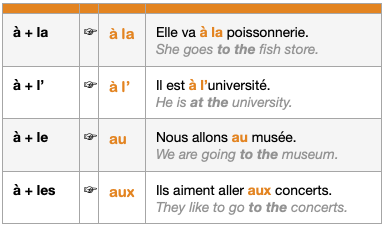
Prepositions are an important part of learning any language. They link two elements of a sentence together. In English, we use prepositions such as on, with, and to very frequently. These little words serve a big purpose in making sentences more meaningful and thoughts more complete.
When prepositions à or de are followed by definite articles le or les in French, these prepositions “contract” with them to form one word. See table below.